Atomic-6 tests Space Armor Lite tile against 7.2 km/s debris impact
Atomic-6 reported that its Space Armor Lite composite tile stopped a 3 mm aluminium sphere fired at 7.2 km/s at Texas A&M University's hypervelocity impact laboratory. A ballistic dummy behind the tile showed no visible damage or penetration, and the tile's rear face had no bulging, cracks or spalling. A 4 mm solid aluminium plate under the same conditions failed, with fragments reaching the dummy. The company is considering the material for astronaut suits, but the test did not involve a suit, pressure system or human injury assessment.
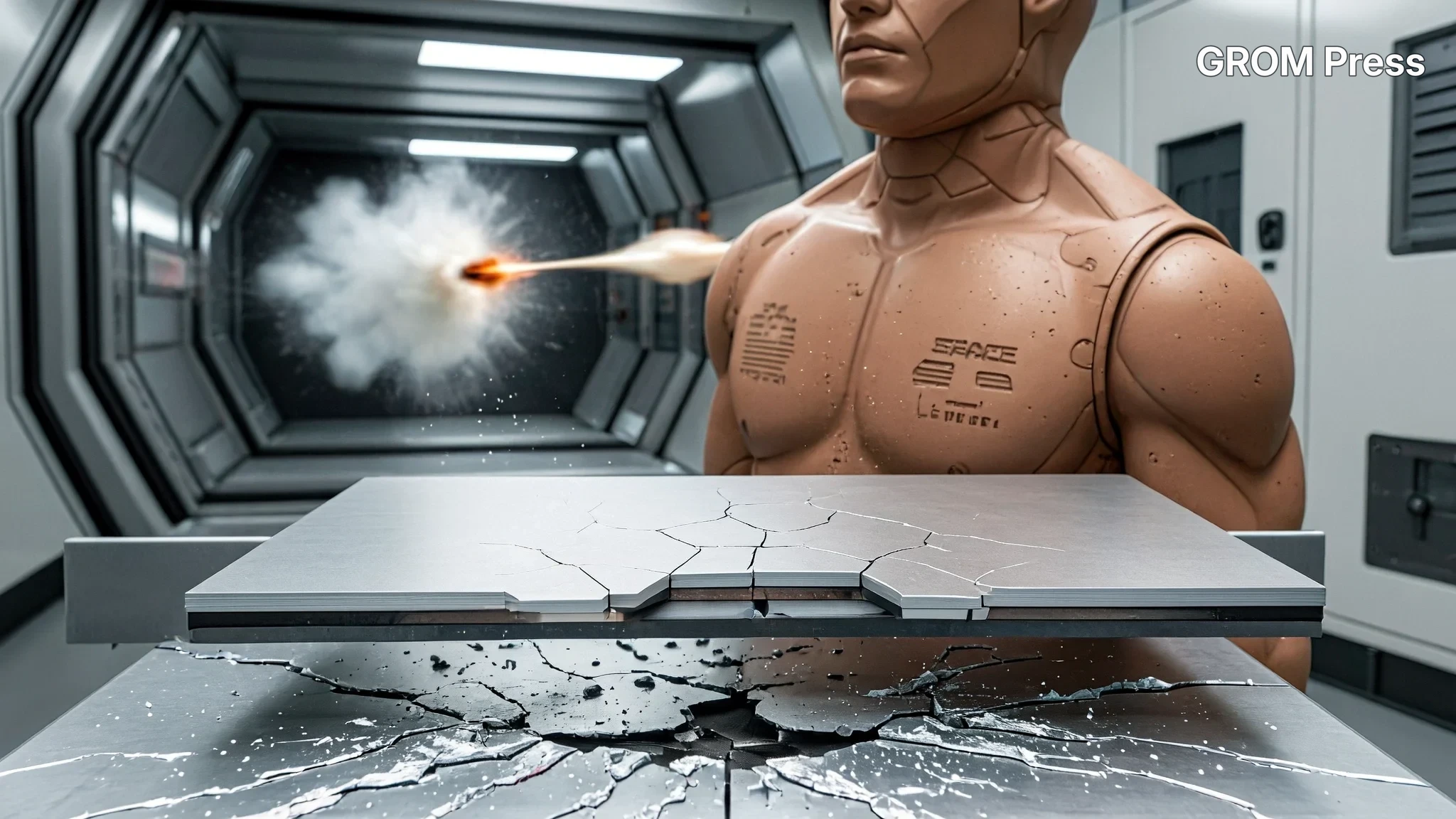
Atomic-6, an American company, reported laboratory tests of its Space Armor Lite composite protective tile, designed to shield satellites from micrometeoroids and orbital debris. The tests were carried out at the hypervelocity impact laboratory of Texas A&M University. A 3 mm aluminium sphere was fired at the tile at a speed of 7.2 km/s. A ballistic dummy simulating soft tissues and bones was placed behind the tile. After the impact, no visible damage or penetration was found on the dummy. The rear side of the tile itself showed no bulging, cracks or separated fragments.
In a control test under the same conditions, a solid 4 mm aluminium plate was used instead of the composite. It did not stop the impact, and material fragments were found in the ballistic dummy.
Atomic-6 said the comparison allows assessment of both the shield's ability to stop an incoming object and the risk of secondary impact from fragments spalling off the inner protective surface. The company noted that the control plate was not a full Whipple shield, which consists of several separated layers that dissipate impact energy, so the test does not prove the tile's superiority over all existing astronaut protection systems.
The tile used in the experiment has an areal density of 14 kg per square metre. According to the company, the material is also significantly thinner than traditional multi-layer Whipple shields, which require several centimetres of space. Atomic-6 originally developed Space Armor for satellites and is now studying its use in spacesuits for astronauts during spacewalks.
The company cautioned that practical use in spacesuits remains distant. The experiment used a stationary dummy without a spacesuit, pressure-maintenance or life-support systems. It did not show what injuries a person would sustain or whether a suit would remain airtight after impact. Atomic-6 plans further checks with curved tiles and other impact angles, aiming to approximate conditions to the shape of a human chest or shoulder.
Source: GROM.PRESS