Phison unveiled Pascari Space SSD line for orbital data centers, with 488 TB planned for StarVault-001 by 2027
Phison announced its Pascari Space SSD series for spacecraft, satellites and orbital data centers. The drives will be used in Lonestar Data Holdings' StarVault-001 orbital data center, expected to launch in the first half of 2027. The station will receive a total of 488 TB of flash memory, of which about 370 TB will be available as usable capacity after deployment in low Earth orbit.
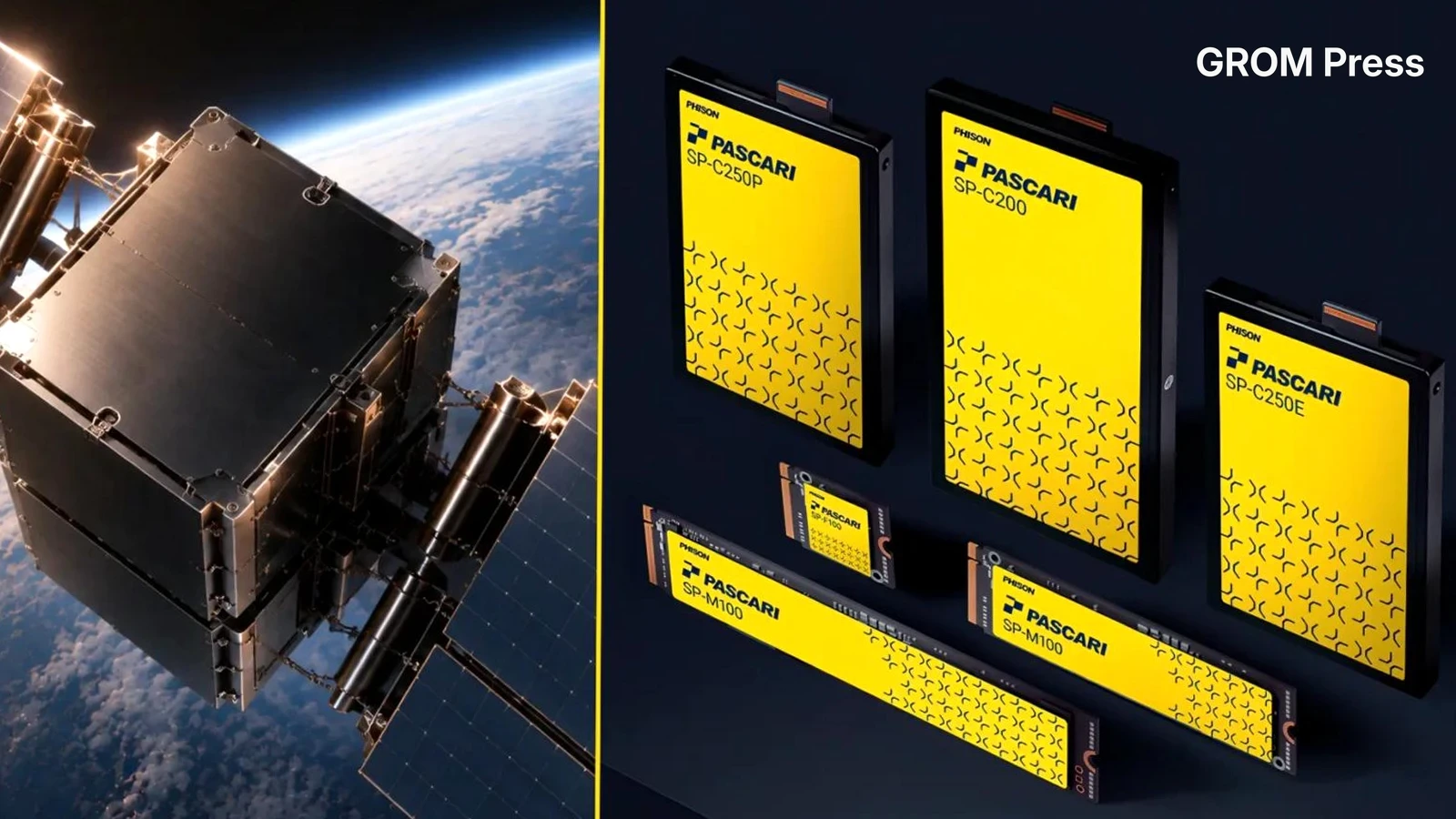
Phison has introduced the Pascari Space line of solid-state drives designed specifically for spacecraft, satellites and orbital data centers. The announcement was reported by Videocardz, citing Phison.
The main event is the planned use of these drives in the StarVault-001 orbital data center developed by Lonestar Data Holdings. According to Phison, the station will receive a total of 488 TB of flash memory. After deployment in low Earth orbit, about 370 TB will be available as usable capacity. Phison specified that this is the combined capacity of all drives in the data center, not a single SSD. Lonestar expects to launch StarVault-001 in the first half of 2027.
The Pascari Space line is divided into three categories. Flight Critical and Main Storage drives use the PCIe 4.0 interface and offer capacities from 40 GB to 4 TB. The Orbital Data Center category uses PCIe 5.0 x4 and includes the SP-C200 with up to 128 TB, the SP-C250P with 32 TB and the SP-C250E with 25.6 TB. These models are produced in E3.S and E3.L form factors.
Temperature ratings vary by model. The Flight Critical SP-F100 is rated for minus 40 to 105 degrees Celsius. The Main Storage SP-M100 is rated for minus 40 to 85 degrees Celsius. Orbital Data Center drives are rated for zero to 70 degrees Celsius.
Phison said the drives can be adapted to specific space missions through its IMAGIN+ engineering services. These services include firmware configuration, radiation testing, adjustment of error-processing mechanisms and data-retention parameters. The SSDs also use LDPC, SmartECC and SmartRefresh error-correction algorithms. Phison claims that switching to pSLC mode instead of the standard TLC configuration in Flight Critical and Main Storage models can increase write endurance by up to 60 times. This is a claim by Phison.
The company also offers separate services for radiation assessment and equipment testing to meet specific mission requirements.
Phison noted that it already has experience with space data-storage systems. Its technologies were previously used in projects related to Mars rovers. In 2025, the company collaborated with Lonestar to send data-center equipment to the Moon.
The significance of the announcement is that a major SSD manufacturer is entering the orbital data-center hardware market with a multi-terabyte storage system scheduled for launch in 2027, positioning itself alongside Lonestar's plans for computing infrastructure in low Earth orbit.
Source: GROM.PRESS