Gaia may find thousands of planets but fail to determine their orbits, astronomers warn
Astronomers have prepared the Epochalypse catalogue of 15,120,984 simulated systems to test methods for the upcoming Gaia DR4 release. The data suggest Gaia may detect many companions around stars but will often be unable to determine their orbital periods because the observation span of about 5.5 years is shorter than the orbital period. In one model, only 1,938 of 29,129 systems with a significant signal yielded precise period and mass estimates, while 27,191 showed a signal without full orbital characterisation.
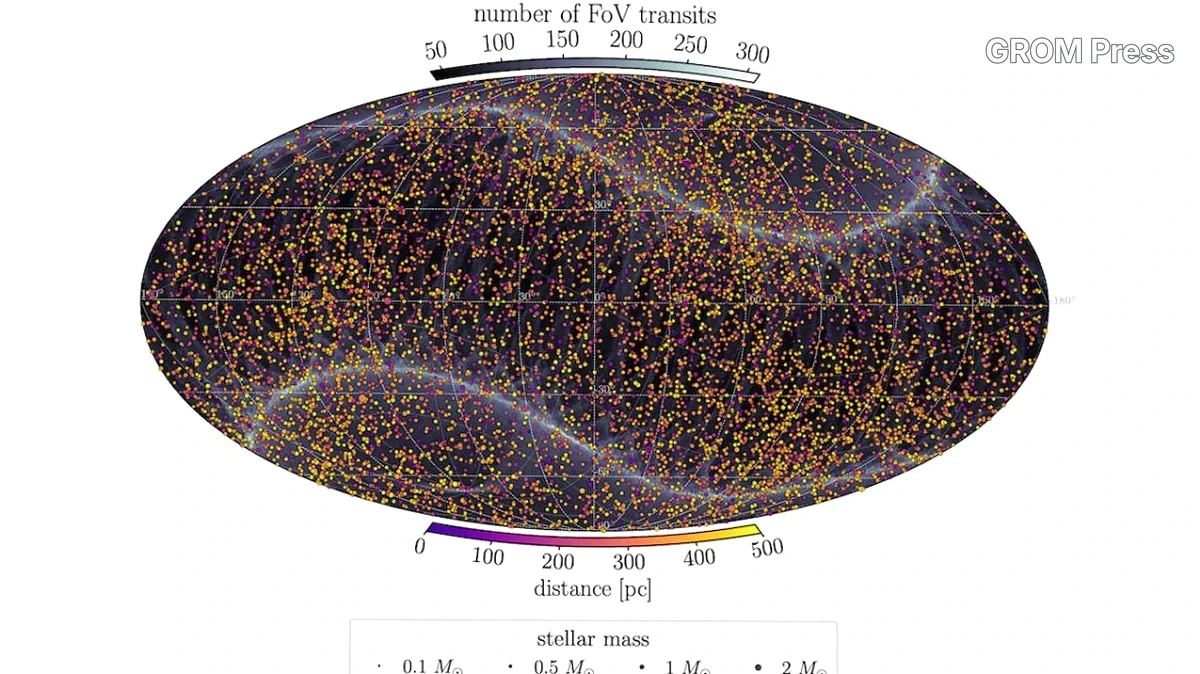
An international team of astronomers has prepared a catalogue called Epochalypse containing 15,120,984 artificially simulated star systems to test detection and orbit-recovery methods ahead of the fourth data release from the European Space Agency’s Gaia space telescope, Gaia DR4. The catalogue is based on 5,040,328 main-sequence stars from the G23H catalogue located within 500 light-years of the Sun. For each star, researchers created three variants: a system without companions, one with a single companion, and one with two companions. The simulated objects range in mass from that of Mars to 80 Jupiter masses, with orbital semi-major axes from 0.03 to 100 astronomical units. The team included objects that Gaia is unlikely to detect in order to assess both search effectiveness and the rate of false detections. Original parameters were stored for every system so that algorithm results can be compared against the exact simulated characteristics.
The researchers tested an algorithm that searches for periodic changes in a star’s position caused by the gravitational pull of a companion, accounting for the number of Gaia measurements per star, the telescope’s scanning direction, and the expected noise level. The analysis identified a fundamental problem with long-period orbits. If a companion orbits its star for longer than the duration of the Gaia observing programme, the telescope may register a change in the star’s trajectory but may not observe enough of the orbit to determine its period. In such cases, the presence of a companion is confirmed while its orbital parameters remain undetermined.
For Gaia DR4, the estimated observing period is about 5.5 years. Orbits with a period of around 3.9 years proved most favourable for companion detection. Outside this range, the ability to determine the orbital period deteriorates rapidly even though the astrometric signal continues to be registered. In the simulated sample of 439,503 potentially detectable single-companion systems, the algorithm identified 204,308 significant periodic signals. The orbital period was localised in 106,339 cases but not in 97,969 cases. In a further 42,771 systems, signs of a companion were detected through stellar acceleration, but the period could not be determined from those signs.
The authors also compared the results with a separate forecast for the Gaia DR4 release. In that model, out of 29,129 systems showing signs of an exoplanet signal, only 1,938 received sufficiently accurate estimates of period and mass. Another 27,191 systems showed a significant signal but did not allow full orbital parameter determination. This means roughly 14 times more objects with a detected companion than with a fully characterised orbit. The estimate may be conservative because that model considered only orbits with periods up to seven years.
The Epochalypse catalogue, the software used to create it, and educational materials on orbit modelling have been published in open access. They will allow astronomers to compare different algorithms on identical data with previously known companion parameters, and after the release of Gaia DR4, to test them on real observations. The main goal of this preparation is to learn to distinguish the mere detection of a companion from the full determination of its mass and orbit.
Source: GROM.PRESS